Soli Deo Gloria
Is Bach's sacred trust also ours to carry?

The short answer is: for sure. But wait!
Before getting into the theory and praxis of inheriting Bach’s “sacred trust”, I want to share some general thoughts, observations, and speculative extrapolations after finally reading John Eliot Gardiner’s biography of Bach: Music in the Castle of Heaven, which has sat on my bookshelf for over a decade, intimidating me with its whiskey bottle box dust jacket design (ironically Bob Dylan’s whiskey label is called “Heaven’s Door” that also has gold leaf on black paper). Regardless, this book shimmers in more ways than one.
I’ll just say upfront that this was the densest book I’ve ever read – and accordingly took forever to finish. There’s just so much information, and JEG (the author) includes so many footnotes about JSB (the subject) that you practically need a magnifying glass to telescope from their tiny font back to the main text. Accordingly, I’ll try to keep my bulleted takeaways to the point, and as succinct as possible. And yes, I do recommend this book for anyone who enjoys Bach’s music and wants to know more about his life.
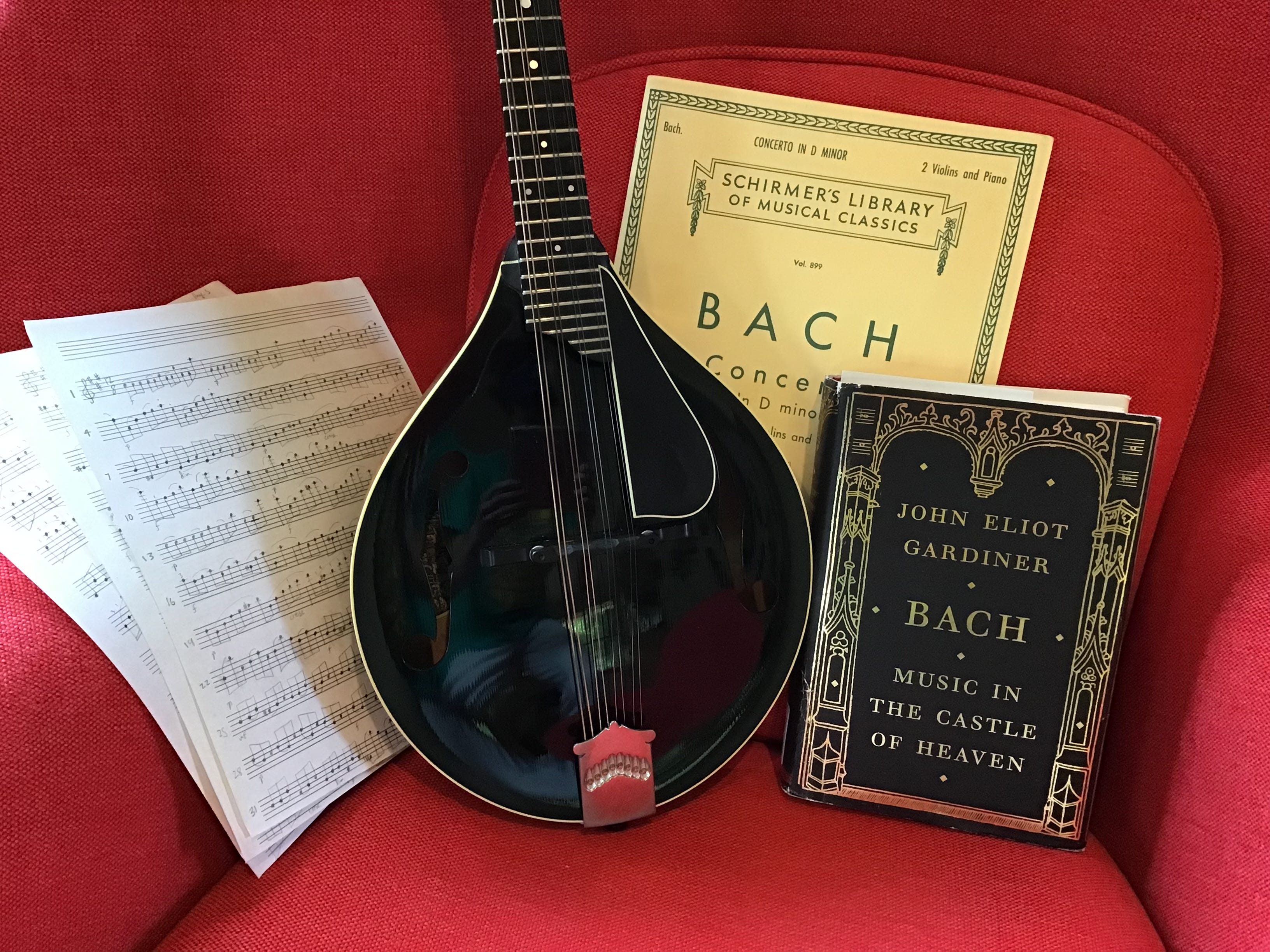
A smattering of nuggets from JEG’s biography of JSB:
In hindsight, as as any creative can relate to, the works other people cherish most are not necessarily what the artist considers to be their own magnum opus (or in Bach’s case, his “endzweck” opera-qua-cantatas for church services). By and large what we love most of Bach’s nowadays are his interstitial works, smaller pieces he composed while dreaming of his endzweck1 and projects he imagined to be more important (which is not to undermine his cantatas, but arguably they have not endured on their own like so many other instrumental compositions of Bach’s, rather the cantatas, as the fruits of his endzweck, require conservation subsidies). Another example that comes to my mind from the realm of visual art is Sargent’s oil painting of Isabella Stewart Gardner (which he had to repaint eight times, taking months) compared to the five-minute sketch he did of his sister Violet using simple watercolors. The portrait of his sister remains my favorite Sargent painting of all time (some might argue it’s a drawing), and I’ve seen many of them in person: the Gardner portrait is oddly looming and hard to appreciate with the angled oil strokes catching glare and dust, whereas the simple matte aesthetic of paper is unobstructed by its own flat medium.
Paradoxically however, we can only guess if Bach would have ever written those cherished interstitial pieces (that are immortalized by their timeless merits) if he wasn’t dreaming of his endzweck – motivated by a higher calling to glorify God. And this raises a larger question: can artwork endure if it does not honor the eternal?
Perhaps serving as the ballast or keel of his big endzweck, Bach had a personal mythological motivation you say: believing his lineage was a direct descendant of the musicians in King David’s Temple. This is one of the more eyebrow-raising tidbits that I had no idea about before reading Gardiner’s biography of Bach who wrote himself in the margins of his Cavlov’s Bible, “This chapter is the true foundation of all church music pleasing to God. A splendid example, that besides other forms of worship music, too, was especially ordered by God’s spirit through David.” So did Bach think he was Jewish in some capacity? He traces the family dynasty back to Veit Bach, a Hungarian baker and miller who played a cittern (similar to a modern mandolin or guitar—or mandocello for that matter!) Either way, there were certainly Jews in 16th century Hungary, so perhaps Veit was a “Jew for Jesus” escaping persecution and fleeing to Germany. There is no evidence to suggest this, so this is purely my hypothetical speculation. But it’s also somewhat ironic (or perhaps appropriate in this light) that the greatest inheritors of Bach’s music, in terms of conservatory repertoire playing, are themselves Jewish such as Yehudi Menuhin, Avi Avital, Jascha Heifetz, Itzhak Perlman, Bronisław Huberman, Murray Perahia, Wanda Landowska, “The High Priestess of Bach” Rosalyn Tureck, and of course Glenn Gould (who said he was not Jewish but who knows). And we can’t forget the Bach-loving conductor and modern composer Leonard Bernstein; the list goes on for great Jewish musicians carrying Bach onward amongst many other legendary gentile talents too.
Myth aside and terrestrially speaking, Bach grew up in the Thuringian Forest. Not unrelated to his deep reverence for the divine, I suspect there is a transcendental force behind Bach’s inspiration – which is to say (and this is my own hypothesis) his music in inextricable from the forest he grew up in and loved; essentially a musical terroir of his tunes which are often regarded as abstractly conceived. But what if they are rooted in place? And what if what we love most about Bach’s oeuvre is the forest that he transports us to (without us realizing we are in a forest, spiritually speaking as we listen to—or play Bach). As this biography does note however by way of the novelist Jay Griffith, “if you take people out of their land, you take them out of their meaning, out of their language’s roots. When wild lands are lost, so is metaphor, allusion and the poetry that arises in the interplay of mind and nature.” Accordingly I think it’s fair to say that BWV is forest music, and inasmuch as forests are timeless (or the cultural source of time) then go figure: for centuries people have cherished Bach’s music for the same reasons that forests will always renew us. We see the forest as “nature” but Bach probably felt it as God’s texture.
Personal tragedy paved the way for his success – regarded in hindsight it’s almost looks as if God was pruning the family tree to allow this scion (in all senses of the word) of Johann Sebastian to grow as high as possible on the Bach bush. Many orphan geniuses have similar stories, and it’s humbling and certainly sobering to think what is required of enabling a timeless genius: what strikes us mortals as mere loss from down here, but is perhaps “all’s well that ends well” and nothing to sweat about from on high. In light of the gifts that an intergenerational genius imparts on humanity, perhaps unexpected deaths in the family is a small cost. Bach himself might’ve felt this way too with a certain bittersweet acceptance, as Luther made it clear that “The timing of any individual death was God’s secret: it is He who ‘sets the clock’ of human life and orders matter according to His own timetable.”
Returning to original ideas and continuing to revise them was central to his work ethic throughout his entire career. Often putting something down (like the John Passion) for ten whole years, only to pick it back up and restore it to its original state after making four or so substantial revisions in attempt to appease patrons and council requests. As any creative idealist can relate to, sometimes a parti pris2 is precious and most inspiring, and demands restoration after the critics leave. Resoundingly optimistic – or simply determined, “Bach was in the habit of saying ‘It ought to be possible to do everything.’ (es muss alles möglich zu machen seyn).”
Bach is testament that art begins with a schedule, or routine – or simply saying no to “FOMO” – trips, parties, and drama that distract from realizing a creative idea. Unlike “Handel, whose travels to Italy provided him with such a fertile source of inspiration. Bach found security in sticking to a regular structure, to proportion and numbers, and to the calendar.” While painfully German sounding, personally I completely relate – just sit down and the art will transpire! But that all said, Bach never shied away from hosting traveling musicians, and maintaining a lively household of song in which the social interaction came to him – “inbound traveling”.
Hilariously preposterous to us but infuriating to him, Bach was repeatedly chastised and sometimes disciplined in front of a panel of authorities for supposedly not working while employed as cantor at the Thomasschule. This is something any employed “creative” can relate to, and is related to the first point of others appreciating works that the artist might’ve cared less for (whereas projects the artist cared a lot for are disregarded by others). Bach clearly worked his ass off, but just not on the work that the Leipzig officials wanted. In his biography that humanizes the composer (rather than deifying him), JEG happily vindicates JSB from any such accusations of idling on the job as “he was casting before the citizens of Leipzig music of a quality and consistency that they scarcely deserved.”
While perusing this biography of Bach, an obvious historical fact hit me: people back then did not have sports – “recreation” as we call it today did not exist for them. Attending church was in some capacity, a pious entertainment, and for those participating in the sermons and song: a seriously athletic endeavor. Secularization was occurring during Bach’s lifetime, with the opera as an obvious example of burgeoning “just for fun” entertainment venues. But clearly people went to church expecting to see feats of extraordinary musical performance, perhaps in a similar way that secular sports fans expect to see a moment of “grace” in a baseball player’s home run hit, or buzzer beater in basketball, and any exhilarating run or winning play in the “beautiful game” of modern soccer. Musicians were not athletes per se, but the physicality and intersubjectivity and challenge of anticipating whether the soloist could pull it off was central to church services in 18th century Europe – or at least in Bach’s Leipzig. Comparable to a stadium experience however, especially during Holy Week, Bach’s greater audience would reach around 10,000 people within earshot (including the 2,500 pew sitters, 500 standing, and 7,000 spilling outside). The city’s total population was 30,000 back then.
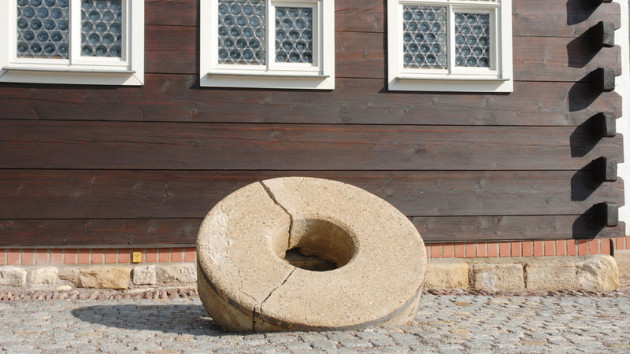
Musicians were diverse and almost like a public utility. There were musicians who played to remind townies what time it was for example, Bach was the son of the “stadtpfeifer” (town piper), there were the freelance “bierfiedler” (beer fiddlers), and while this kind of vocation was more of the antecedent to Bach’s emergence (and certainly less prestigious than the emerging court patronages of that exciting new era) music was woven into every aspect of public life. Private hobbyists seemed to be rare, ironically found amongst either the peasants or the noblemen, but not necessarily merchants in between (although I see no reason why not). Regarding the former, Bach’s great-great grandfather played his cittern the “beat” of the mill (that served as a giant metronome according to legend).
Bach was hooked on coffee, and arguably his music is substantially infused by caffeine, like many intellectual endeavors of the 18th century and Age of Enlightenment which unabashedly enjoyed its hotly steeped uppers.
Maybe related to this, but it seemed like everyone was an inch away from a brawl back in the 18th century – lots of stamping on wigs and fining offenders beers. Flirting and fighting did not stop in church either, hence the turbatio sacrorum.3
Accordingly, Bach played regularly at Zimmerman’s Koffebaum (coffeehouse) in Leipzig – where he debuted and performed his famous “Koffee Kantate” that is still reenacted in its historical setting (or at least in the same neighborhood). The 18th century coffee house stood in antithetical contrast to the church as well, not in any offensive way, but was clearly where secular intellectualism and modern discourse flourished, along with the socially accepted presence of career coffee prostitutes of sorts: young women who flirted with patrons for a fee. Young men were advised to stay on their guard when visiting a joint run by caffe-menscher.4 Perhaps the (seemingly west coast phenomenon) of the topless and bikini coffee stands is an inheritor of this particular fashion, hybridized with the American “drive-thru” culture.
Bach was repeatedly baited into a rhetorical defense of his honor by lesser men. Often hiring a friend to write such responses for him, they only ever set him back and never advanced his musical career at all. The lesson to take from this thread in the book is: never respond to petty rivals who are motivated by jealousy, but Bach was insecure about his lack of intellectual vocabulary (which was flourishing at that time, and associated with authority) so he could not resist—to his detriment.
Most of what Bach played was improvised! And never transcribed for future reference – the dude was basically a proto-bebop baroque wizard, easily ripping cadenzas and counterpoint without ever needing to hash it out with pen and ink. There are certain measures of the cello suites if played with swing sound like a Charlie Parker line – and conversely some moments from Parker’s solos as transcribed in his Omnibook that if played straight sound like a baroque cadenza. I like to joke that Bach and Bird were time-traveling alter egos of the same interdimensional musical genius. Regardless, what we have of Bach’s work is undeniably a fraction of what he actually conceived, since Cristoph Wolff estimates that nearly two-fifths of the cantatas alone were lost one way or another because the estate was split up.
Especially his church cantatas, but even his instrumental work was thoroughly allegorical or to say the least: narrative inspired, sometimes note by note! I had no idea that Bach was effectively casting particular instruments as Biblical actors or metaphorical agents in general. When we listen to Bach’s instrumental music in particular, it feels mathematically elegant and pleasing, but I would’ve never guessed that he (at least in no small part) was thinking about storytelling.
I’ve always suspected there is a sense of humor in some of Bach’s work, and sure enough he did not shy away from flexing his allegorical compositional powers to satire either the Pietist clergy, the Leipzig intelligentsia, or popular sentiments of his own time. While Bach referred any piece of his that was mined intraoeuvrally as “parodies” – he clearly had a knack for satirizing things beyond his repertoire entirely. Centuries later Shostakovich echoed Bach’s sentiment by saying, “I want to fight for the legitimate right of laughter in ‘serious’ music.” Amen! And not just in music, but in any “serious” art. While not exactly a joke, there are punchlines in Bach’s partitas that resolve a setup of sorts, causing any instrumentalist to smile.
We can’t know for sure how audiences received Bach’s music, or how it sounded to them in 18th century Leipzig, but chances are his tonus peregrinus5 tripped up performers and especially if fumbled: would’ve been heard as halfhearted blips rather than harmonic tricks. Bach loved thinking about the tectonics of harmony, establishing a systemic structure to any given piece, while also dialing into all the details with a perfectionistic glee. My hunch is that people back then were no less prone to regarding Bach as pretentious or difficult to relate to as many listeners might claim to feel in the 21st century. As an architect of harmony, Bach never asked for permission, and in a sense did not care for approval either, he was in his mind on a mission from God, not unlike Jake and Elwood from Blues Brothers but for totally different reasons. The legacy he left is testament to such intransigence. The 19th century biographer Forkel summed it up as, “He [Bach] believed the artist could form the public, but that the public could not form the artist.”
That said, Bach’s modus operandi was – if not two things then certainly – bivalent toward both God and his neighbors (i.e. other people), incorporating the Lutheran ethos of “giving honour to God (the standard Orthodox position) and for edifying one’s neighbour (the slant favored by the Pietists).” This is to say, Soli Deo Gloria meant doing his best for God, but also humanity – even if they don’t “get it”.
D Major was considered to be the royal key, and F# minor the “key of the goat”. Furthermore Eb minor was known as the (six flats) signature of “deepest distress, of brooding despair, of blackest depression, of the most gloomy condition of the soul”. I’ve always associated certain keys with colors (and even flavor), but this was funny to learn considering how most of Chris Thile’s original compositions are in D Major – as a mandolinist myself, I sometimes wonder if this is the (royal) bias of the instrument. Just like a violin, the mandolin is key-agnostic and versatile across scales, but D Major is “centered” nicely on the instrument you could say, at least in some ergonomic capacity.
Fundamentally, Bach did not like how opera was a production that was consumed by a passive audience – he “knew perfectly well what opera was and seems to have decided quite early in life that it wasn’t for him.” Bach wanted participants, and this desire remains as a timeless invitation to join his so-called sacred trust. Even in secular terms, I would say that he was spot on: music is first and foremost for playing – not producing, not consuming. Playing with a higher purpose in mind!
Compassionately composed, Bach believed music should express bonae voluntatis6 and as he inscribed in his Musical Offering (BWV 1079), quaerendo invenietis.7


Taking a crack at the Ciaconna while tackling this book:
However oversimplified, Bach’s MO of Soli Deo Gloria is an intrinsic motivation – doing something (at least from the perspective of others) for its own sake. While we know he was in fact doing it for God and the edification of his neighbors (humanity), to say the least having a “just do it” attitude suffices to go far and deep with any art.
Goes without saying, the Nike slogan will never result in sacred music and would be considered an insufficiently ordered “endzweck” for Bach. But for us amateurs, it’s not a bad place to start when diving into some of his work. As I slowly read this biography I thought I’d pair it with the famously challenging Ciaconna, which is eight pages long and was written by Bach to process the grief after his first wife Maria passed away.
In philosophical terms, I regard Bach’s Ciaconna as an exemplary work of the shadow arts where a visionary undergoes death to discover new life, which is the opposite of the dark arts that sacrifices life to avoid death.
This piece is a hobby unto itself, and I’m in awe that some of those aforementioned musicians (such as Avi Avital) can play it from memory! Imagine the neural pathways that form by doing so; that’s next-level and perhaps someday I’ll hammer a bunch of harmonic heuristics into my head to commit this thing without having to look at the sheet music for reference. But for now, this is what I got…
Speaking of heuristics, as you can see in the video I’ve annotated the notes using the classical guitar “PIMAC” letters, except for my left hand (thus only “IMAC”) to make sure I’m fingering each phrase without twisting myself into a dead end. This is the delightful challenge of a max-difficulty Bach piece such as the Ciaconna, as he has written out everything to be just barely possible given the fact the violinist (as it was originally written for) has only four fingers to press notes with (and one bow).
For a long time I wasn’t sure if I was playing it “wrong” in terms of my chosen positioning and fingering – but was relieved to hear Chris Thile say in an interview not long ago that this is part of the fun of Bach: figuring out how you want to play it tactically speaking – and that there are multiple valid ways to do it. That said, there are certain passages that as far as I can tell: Bach intended for the violinist to do it one and only one way: positioned and fingered in the only viable fashion. Such moments almost serve as calibration points: bringing the musician back to single solution beyond which they can deviate in their own expression interpretation. There are lots of these technical bottlenecks (another way to think of them), especially in the cello suites when a phrase shifts position and spans large intervals – Bach makes it just barely possible, which is fun to imagine how he experimented to write it like so.
Inheriting SDG in an operatic world of passive consumerism:
There’s so much more to be said about this book, learning Bach, the philosophy and practice of music in general, the importance of the amateur in maintaining authentic (i.e. for its own sake) repertoires, so on and so forth. But I think the key is to trust that Bach’s ethos of Soli Deo Gloria is anywhere music inspires people to stop in awe – not constrained to the church (as Bach himself mostly played at Zimmerman’s late in life after concluding his endzweck mix of cantatas, motets, oratorios, plus passions) and certainly not limited to what we call “baroque” music as a genre.
At a bare minimum, simply sitting down as Bach did trying to figure out the harmony of the world first and foremost as a player (and not a producer or consumer) is a good place to start if we are to carry his sacred trust. This always begins with solitude, as an art teacher once told me, “Draw the lines that only you and God can see.” which could mean any number of things (he was a WWII vet, amazingly still teaching drawing and sculpture back in the early-aughts) but I think that’s the right idea—and the core of it.
In closing, a sampling of interesting excerpts to take from the book:
“The dedication of his art to God’s glory was not confined to signing off his church cantatas with the acronym S[oli] D[eo] G[loria]; the motto applied with equal force to his concertos, partitas and instrumental suites.”
“His music never stops praying.” as the contemporary György Kurtág admits with awe and reverence, “Consciously, I am certainly an atheist, but I do not say it out loud, because if I look at Bach, I cannot be an atheist.”
“Luther is often said to have asked why the Devil should have all the good tunes. To make sure that he didn’t, Luther and his followers appropriated secular melodies that everyone in his congregation knew, redirecting the candid earthiness and bawdiness of folksongs to the service of faith, for ‘the whole purpose of harmony is the glory of God’, he claimed; ‘all other use is but the idle juggling of Satan.’”
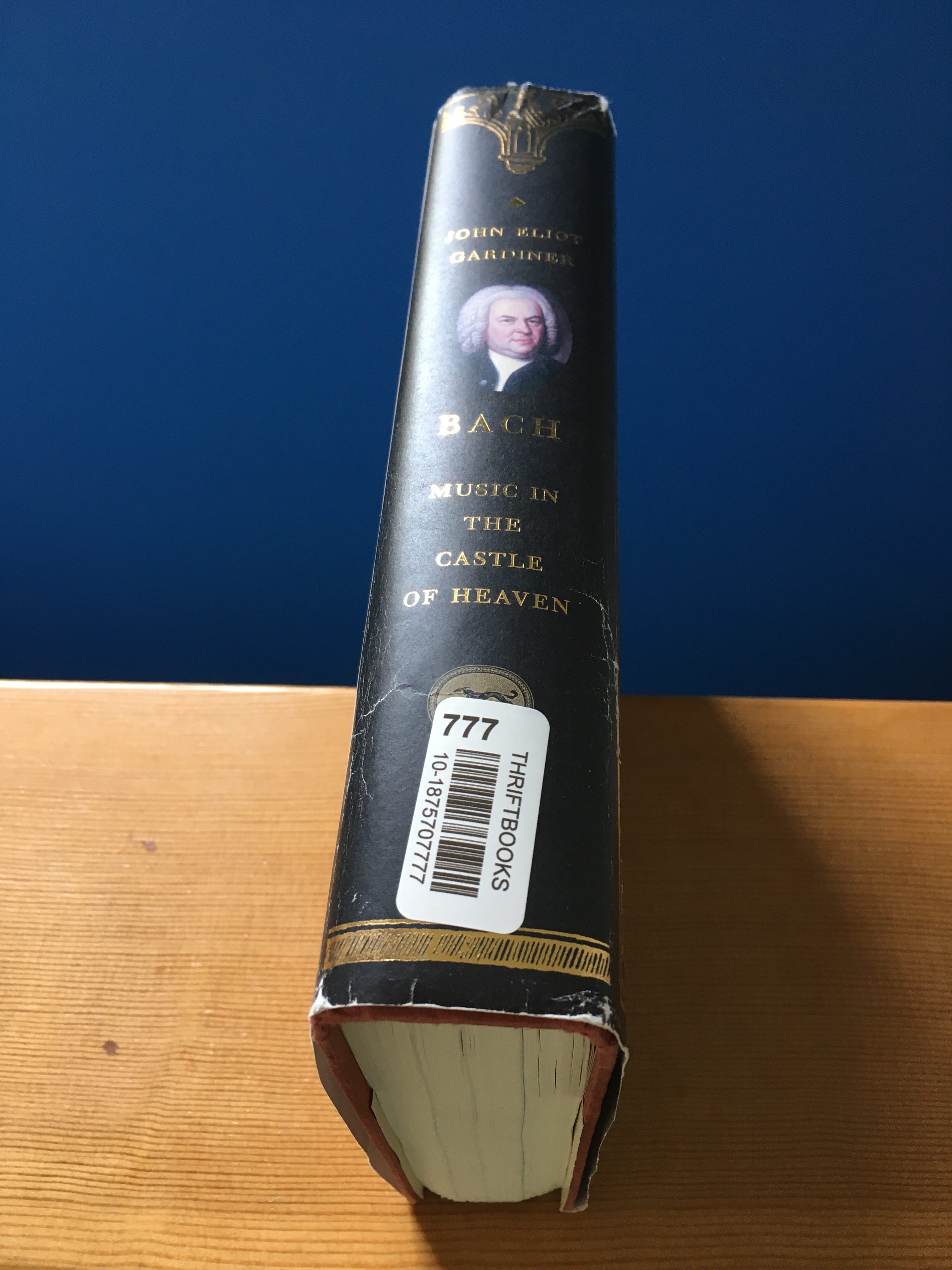
The book is “short for Weg zur Himmelsburg (‘The way to the castle of Heaven’), this referred to the painted cupola depicting the open heavens in the palace church in the Wilhelmsburg, the centre of Duke Wilhelm Ernst’s devotions.”
“In effect he [Duke Wilhelm Ernst] stood as patron of fully half of Bach’s extant organ music – the fraction, that is, to have survived in written form (the majority being the improvisations that emanated from Bach’s creative mind, which disappeared instantly into the celestial ether of the Himmelsburg).”
“For him invention was an uncovering of possibilities that are already there, rather than something truly original – hence his view that anyone could do as well, provided they were as industrious. God is still the only true creator.”
“What is most valuable about this sort of approach is that Bach could be shown to be at his most creative when his chosen inventive material falls short in some way, or when some sort of irregularity gives rise to ideas that he probably would not otherwise have had.”
“The truth is that stylistic impropriety was a badge of Bach’s approach to invention in a culture that was not equipped to deal with its originality. As Birnbaum said of Scheibe, he ‘attempted to make Bach’s works repulsive to delicate ears’. The imaginative richness of Bach’s music – one of the qualities we now admire and savour perhaps as a result of what we have learnt from later compositions – clashed noisily with the cultural values of his day and undermined widely accepted ideas of decorum.”
“When I first heard the [BWV 95] cantata, in the late 1960s, in a Karl Richter performance, I was struck by Bach’s utterly original combination of corno and oboes locked together in a combative tussle. ‘Jazz trumpets’, I thought at the time, and there is indeed something of a jam session feel to this passage.”
“The truth is that the cultural milieu which Bach was leaving behind at his death was not yet ready for the degree of independence of thought and conception that he manifested here. We are his successors and the beneficiaries of his vision. Every time we perform it marks just the latest point in the work’s continuing and continuous unfolding.”
“Above all, as musicians you can never afford to be earthbound – to plod, in other words: it has to dance. Ultimately his style is also vision. Misjudge the style and you miss the vision.”
Literally “ultimate goal” but in Bach’s words, to compose “namely, a well-regulated or orderly church music to the Glory of God and in conformity to your wishes.”
Literally “side taken” and endemic to the beaux-arts of architecture, but retroactively relevant to Bach’s visionary approach of identifying an original idea and sticking with it.
Literally “disturbance of the sacred” during church. In 1722 an electoral decree (reissued twice in the following years) attempted to stop this “inappropriate walking to and fro during the sermon and by throwing [objects] from the galleries on to the women beneath."
Literally “coffee girl” who were also referred to derogatorily as “coffee-trollops”. These bean maids inspired Bach’s satirical Koffee Kantate written for Zimmerman’s in 1734. Coffee was seen as a dangerous aphrodisiac for men and addiction liability for women, although just like our century: no one could be certain if the habit was unhealthy or not.
Literally “wandering tone” but in Bach’s music could be an unexpected accidental, like a C# that was natural just a few beats before in a similar run. The term has formal meaning in the context of psalms, but for baroque composition it can mean basically “jazz notes”.
Literally “of good will” to men, often associated with Latin Mass, from Luke 2:14.
Literally “seek and you shall find” as Bach was referencing the Sermon on the Mount, and “inviting future generations to search for the solution themselves” for his incomplete fugue. The statement is found in the Gospels in both Matthew 7:7 and also Luke 11:9.